Wisdom Teeth Removal
Relieve pain and prevent future dental complications with expert wisdom teeth removal at Bharati Dental Hospital. Our specialists ensure a safe, comfortable, and precise procedure tailored to your individual needs.
Introduction
What are wisdom teeth?
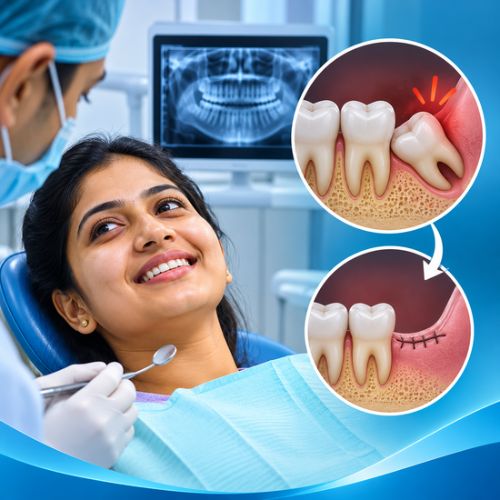
Wisdom teeth, also known as third molars, are the final set of teeth to emerge, typically appearing in the back corners of the mouth between the ages of 17 and 25. Most adults have four wisdom teeth- one in each corner. Though it is common for some people to have fewer or even none at all. Because these teeth are the last to develop, the jaw often lacks the necessary space to accommodate them, which is why they are frequently associated with dental complications.
When wisdom teeth do not have enough room to erupt properly, they may become “impacted,” meaning they remain trapped under the gumline or grow at an angle. This can lead to various issues, including intense pain, swelling, and damage to neighboring teeth. To prevent these problems and maintain overall oral health, many dentists recommend monitoring wisdom teeth closely or removing them before they cause structural shifts or infections in the mouth.
Common issues caused by wisdom teeth
When wisdom teeth don’t have enough room to grow in properly, they can create a domino effect of oral health problems. Since their location is at an awkward place in the mouth, they are difficult to clean and often interfere with the health of your existing teeth.
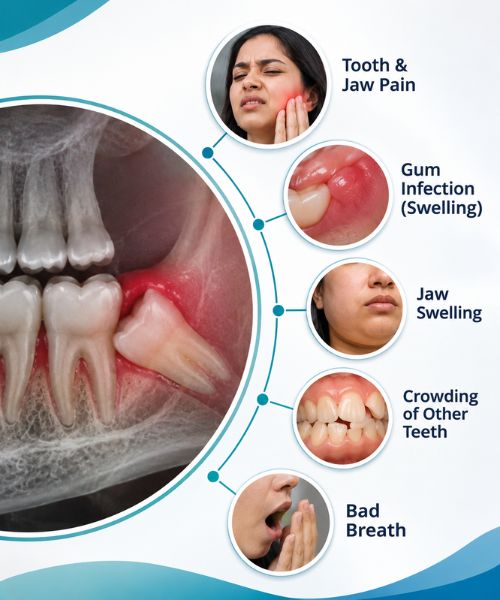
Here are the most common issues caused by wisdom teeth:
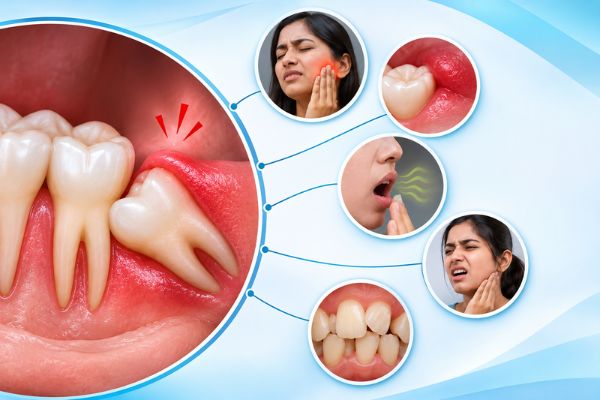
An “impacted” wisdom tooth is one that is stuck under the gumline or trapped against another tooth. This pressure can cause a persistent, dull ache or sharp pain that radiates through the jaw and even into the ears and head.
Most people don’t have extra room in their mouths for four large molars. As wisdom teeth try to force their way in, they can push your other teeth out of alignment. This can ruin years of orthodontic work (braces) and cause your front teeth to overlap or crowd.
If a wisdom tooth only partially breaks through the gum, it creates a small flap of tissue. This area becomes a “food trap” that is impossible to reach with a toothbrush. Bacteria quickly build up, leading to a painful infection called pericoronitis, characterized by swollen gums and a bad taste in the mouth.
Wisdom teeth often grow in at an angle, leaning directly into the roots of your second molars. This constant pressure can wear down the enamel of the healthy tooth next to it, leading to cavities, root damage, and even the loss of the second molar.
In rare cases, a sac of fluid (a cyst) can form around the crown of an impacted wisdom tooth. If left untreated, these cysts can grow and damage the hollow interior of the jawbone or destroy the roots of nearby teeth.
Frequent dental examinations are necessary to help keep a tab on the growth of wisdom teeth and treat any problems early. In order to prevent these possible issues, your dentist can determine whether preventive removal could be advantageous.
Top 5 Signs You Need Wisdom Teeth Removal
- Persistent Jaw Pain: A dull ache or throbbing at the back of the jaw.
- Swollen or Bleeding Gums: Redness or tenderness around the very back molars.
- Bad Breath or Unpleasant Taste: Caused by bacteria trapped under the gum flaps.
- Difficulty Opening Your Mouth: Stiffness or pain when chewing or yawning.
- Visible Crowding: Noticing your front teeth starting to shift or overlap.
Key Points Taken Into Consideration
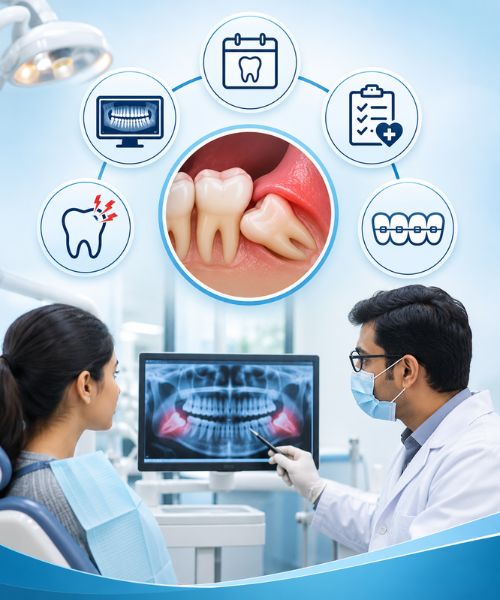
When wisdom teeth removal becomes necessary, these are some points taken into consideration by our expert dentists:
- X-ray images displaying the position of the teeth
- What is the intensity of the current symptoms?
- What is the age and fitness level of a patient? Does he have any health issues?
- Whether there are any potential chances of further complications?
- Will there be any effect on the dental treatments that are already done?
Late teens to early twenties is the ideal time for wisdom teeth removal since the procedure is easier and recovery is faster at this age. However, removal may not be required if wisdom teeth are fully erupted, functioning, and cleanable.
Keep in mind that every instance is different. Your dentist offers tailored guidance according to your particular circumstances. Early identification guarantees the best possible preservation of dental health and helps to avert possible problems.

What are the types of Wisdom Teeth Removal?
Wisdom tooth extractions are not all the same; the technique used depends entirely on how far the tooth has emerged through the gum line. Understanding these types helps set the right expectations for your procedure and recovery time.
1. Simple Extraction
A simple extraction is performed when the wisdom tooth has fully erupted and is visible above the gum line.
- The Procedure: Your dentist or oral surgeon uses specialized instruments to loosen the tooth and remove it. Since the tooth is already accessible, this is a quick process.
- Best For:Teeth that are growing straight but need removal due to decay or lack of space.
2. Soft Tissue Impaction
This occurs when the crown of the tooth has moved through the jawbone but is still covered by gum tissue.
- The Procedure: A small incision is made in the gum to expose the tooth so it can be removed. A few dissolvable stitches are often required to help the gum heal.
- Best For: Teeth that are partially visible but trapped under a "flap" of gum.
3. Partial Bony Impaction
In this case, the tooth is partially encased within the jawbone. It may be growing at an angle, making it impossible to emerge fully.
- The Procedure: To remove the tooth safely, the surgeon may need to remove a small amount of surrounding bone. Often, the tooth is divided into smaller sections (sectioning) to make the exit as gentle as possible for the jaw.
- Best For: Teeth tilted toward the front or back of the mouth.
4. Full Bony Impaction
This is the most complex type of extraction, where the tooth is completely encased in the jawbone. These teeth often lie horizontally or are deeply embedded.
- The Procedure: This requires a more detailed surgical approach to carefully navigate the bone and protect nearby nerves. Because this is a more involved surgery, it is typically performed under deeper sedation to ensure patient comfort.
- Best For: Teeth that are lying sideways or are completely hidden beneath the bone.
Which type of wisdom teeth removal is suitable for me?
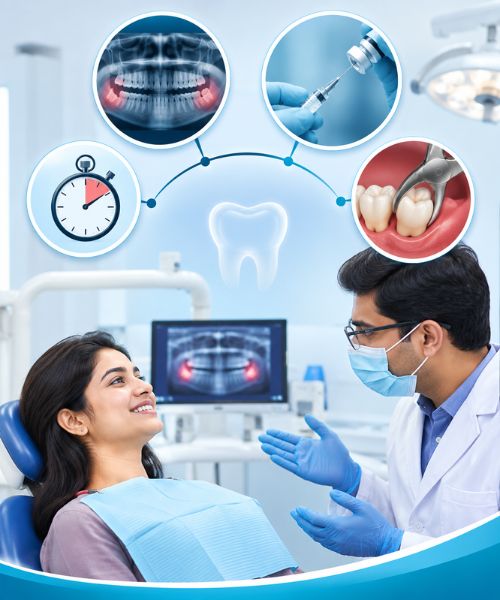
Every case is different. The complexity of your extraction is determined by a Digital X-ray or OPG (Full Mouth X-ray). At Bharati Dental Hospital, we use these clear images to map out the exact position of your roots and nerves, ensuring your wisdom tooth removal can be done in a safe and smooth manner.
Wisdom Tooth Removal Preparation
Knowing what to expect can definitely help in reducing one’s anxiety before the procedure. At Bharati Dental Hospital, we prioritize your comfort and transparency from the moment you walk in.
- Detailed Imaging: We begin with a digital X-ray or OPG to see the exact angle of the roots and their proximity to nerves.
- Personalized Anesthesia: We promise, you won't feel a thing after the anesthesia is given! Depending on the complexity of the case, we use local anesthesia to numb the area, or conscious sedation for a completely relaxed experience.
- Pressure, Not Pain: During the procedure, you may feel a sensation of "pressure" as the tooth is being moved, but you should not feel any sharp pain.
- Duration: A simple extraction can take as little as 20 minutes, while more complex surgical extraction can take anywhere between 45-60 minutes.
What happens during the actual wisdom teeth removal?
- START
1
Numbing and Preparation
2
Accessing the Tooth
3
Sectioning the Tooth
4
Cleaning and Closing
5
The Healing Foundation
- FINISH
Post-Operative Care Wisdom Teeth Removal
1. The First 24 Hours: Protecting the Clot
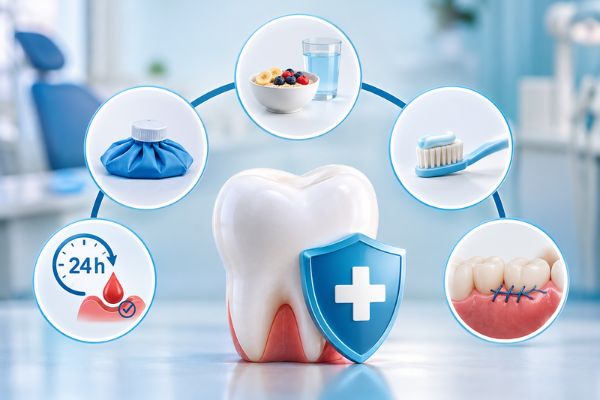
The formation of a blood clot in the area of wisdom teeth removal is the most important part of healing. This in fact, acts like a protective bandage over the bone and nerves.
- Bite on Gauze: Keep firm pressure on the gauze pad provided for at least 30–60 minutes. If bleeding continues, replace it with a fresh pad.
- Do Not Disturb the Site: Avoid spitting, rinsing forcefully, or touching the area with your tongue or fingers.
- No Straws: The suction from a straw can dislodge the blood clot, leading to a painful condition called Dry Socket.
Rest: Keep your head elevated with pillows and avoid any strenuous physical activity.
2. Managing Swelling and Pain
- Ice Packs: Apply an ice pack to the outside of your cheek for 15–20 minutes at a time during the first 24 hours to minimize swelling.
- Medication: Take your prescribed pain relievers or antibiotics exactly as directed by our dental surgeon. Do not wait for the pain to become severe before taking your first dose.
- Saltwater Rinses: After the first 24 hours, gently rinse your mouth with warm salt water 4–5 times a day to keep the area clean and kill bacteria.
3. Nutrition and Hydration
- Soft Food Diet: For the first few days, stick to soft, “no-chew” foods like lukewarm soups, mashed potatoes, curd rice, khichdi and dalia. Avoid eating nuts or crispy vegetables as well as spicy foods as they may irritate the operated area of your mouth.
- Avoid Heat: Do not consume very hot foods or beverages, as heat can dissolve the blood clot.
- Stay Hydrated: Drink plenty of water, but remember to sip directly from the glass without using a straw!
4. Oral Hygiene
- Brushing: You should continue to brush your other teeth, but do it very gently for cleaning the area near the extraction site.
- Smoking & Alcohol: Avoid smoking and alcohol for at least 72 hours. Smoking significantly delays healing and increases the risk of infection.
5. Stitches
- Your dental surgeon will let you know whether your stitches are dissolvable or not. If not, they may ask you to visit the hospital in a week’s time.
- You should feel normal in 1-2 weeks as healing time changes from person to person.
When to Call Us Immediately
While minor oozing and swelling are normal, contact Bharati Dental Hospital if you experience:
- Severe pain that does not improve with medication.
- Heavy bleeding that doesn't stop with gauze pressure.
- High fever or a foul-smelling discharge.
- Numbness lasting more than a day after surgery.